Thursday, April 20, 2017

Week 11 Post 1: Ethics

At its simplest, ethics is a system of moral principles. They affect how people make decisions and lead their lives. Ethics is concerned with what is good for individuals and society and is also described as moral philosophy. The term is derived from the Greek word “ethos” which can mean custom, habit, character or disposition. Ethics is useful in almost every setting. If ethical theories are to be useful in practice, they need to affect the way human beings behave. Some philosophers think that ethics does do this. They argue that if a person realizes that it would be morally good to do something then it would be irrational for that person not to do it. But humans often behave irrationally, they follow their 'gut instinct' even when their head suggests a different course of action. However, ethics does provide good tools for thinking about moral issues.

In an organization, a code of ethics is a set of principles that guide the organization in its programs, policies and decisions for the business. The ethical philosophy an organization uses to conduct business can affect the reputation, productivity and bottom line of the business. A professional code of ethics sets a standard for which each member of the profession can be expected to meet. It is a promise to act in a manner that protects the public’s well-being. The code of ethics informs the public what to expect of one’s doctor, lawyer, accountant, or property manager.

 Leaders and employees adhering to a code of ethics create an ethical organizational culture. The leaders of a business may create an ethical culture by exhibiting the type of behavior they'd like to see in employees. The organization can reinforce ethical behavior by rewarding employees who exhibit the values and integrity that coincides with the company code of ethics and disciplining those who make the wrong choices. A positive and healthy corporate culture improves the morale among workers in the organization, which may increase productivity and employee retention, which in turn has financial benefits for the organization. Higher levels of productivity improve the efficiency in the company, while increasing employee retention reduces the cost of replacing employees.

Ethics is a very important aspect in healthcare and the concerns of medical ethics are considered the most important and consequential in human life. Part of the importance of medical ethics comes from the fact that members of the medical and health care professions are granted powers and privileges that are not granted to non-members. Surgeons and doctors have the right and duty to cut open the human body if they are convinced that by doing so they can improve or aid the health of the person being cut open. Medical professionals sometimes have the responsibility to determine or decide who is to live and who will die. They can prescribe powerful drugs and chemicals that could be poisonous or otherwise harmful if improperly administered. They make decisions about the use and allocation of large amounts of money and scarce resources. They decide how patient care is to be delivered, which patient should get which resources, how much and what patients should and will be told about their situation, what kind of doctor-patient interaction will occur, and whether the information given to them by patients will be kept confidential, and it is not how and to whom it will be shared.

Week 10 Post 2: Organizational Culture


Organizational culture is a system of shared assumptions, values, and beliefs, which governs how people behave in organizations. These shared values have a strong influence on the people in the organization and dictate how they dress, act, and perform their jobs. There has been a lot of debate to what organizational culture really means. There is a universal consensus that organizational culture does in fact exist, and that it plays an important role in shaping behaviors in organizations.

I found an article on The Harvard Business Review, in which the author created a discussion board on LinkedIn and asked people to post what they thought organizational culture was/meant.

Some of the responses are as follows: (taken directly from the HBR article - https://hbr.org/2013/05/what-is-organizational-culture)

- “Culture is how organizations ‘do things’.” — Robbie Katanga

- “Organizational culture defines a jointly shared description of an organization from within.” — Bruce Perron

- “Organizational culture is civilization in the workplace.” — Alan Adler

- “Culture is the organization’s immune system.” — Michael Watkins

- “Organizational culture is shaped by the main culture of the society we live in, albeit with greater emphasis on particular parts of it.” — Elizabeth Skringar

- “It over simplifies the situation in large organizations to assume there is only one culture… and it’s risky for new leaders to ignore the sub-cultures.” — Rolf Winkler

- “An organization is a living culture… that can adapt to the reality as fast as possible.” — Abdi Osman Jama

The response that I found the most interesting was the one that said culture is the organization’s immune system. I found it interesting because I would never have thought of it like that. However after reading how the author explained it, it made a lot of sense to me.

The author said, “Culture is a form of protection that has evolved from situational pressures. It prevents “wrong thinking” and “wrong people” from entering the organization in the first place. It says that organizational culture functions much like the human immune system in preventing viruses and bacteria from taking hold and damaging the body. The problem, of course, is that organizational immune systems also can attack agents of needed change, and this has important implications for on-boarding and integrating people into organizations.” (https://hbr.org/2013/05/what-is-organizational-culture)

I found another article that said the most important thing about culture is that it’s the only sustainable point of difference for any organization. Anyone can copy a company’s strategy, but nobody can copy their culture. I agree with this statement and believe that an organization’s culture can have an immense influence on why employees want to work for your organization. I also believe that the culture plays a big role in employee satisfaction.

Thursday, April 13, 2017

Week 10 Post 1: Team Leaders and Performance


Since the third section of our class is focused on “Many” or teams and teamwork in the workplace, I was interested in what is considered as being a good team leader. I found an article by EY in which they discuss what they believe are four key attributes to being a team leader in their organization. EY is one of the largest and most well-known finance companies in the world.

It is obvious that strong leadership is a prerequisite for any high-performance team. It is also particularly important in dynamic situations, such as when the roles and responsibilities of the team may be shifting and there may be a need to adapt the organization’s responses accordingly. There are certainly a numerous amount of professionals in today’s society who encompass the ideal characteristics of modern day team leadership, however finding the individuals that fit your organization is not easy.

EY discusses four main attribute of successful team leaders, which are: (tken directly from EY's website - http://www.ey.com/gl/en/issues/talent-management/four-attributes-of-effective-team-leaders)

  1. Provide clear direction and leadership: This requires constant dialog, particularly if the team is distributed across geographies and functions. With teams now spread far and wide, regular contact should be actively planned and prioritized. But while structure is important, companies also need to ensure that processes are not too rigid.
  2. Create an open and inclusive team culture: Effective leaders of high-performance teams encourage members to voice views and ideas. Leadership in a team setting is much less about command and control, and more about getting the most out of a diverse and experienced group of individuals.
  3. Empower: Old-style command-and-control leadership models are not fit for purpose in a high-performance team setting. Although they lay the groundwork for team activities, effective leaders also know when to get out of the way, and empower team members to be autonomous and make their own day-to-day decisions.
  4. Develop and coach: Workplace surveys consistently demonstrate the potential impact of the manager on an employee’s attitude towards their work. Without the leader’s constant encouragement, individual demoralization can quickly infect the team.
I agree that these are certainly 4 key attributes to have today in order to be a successful team leader, however they are not the only characteristics of a good team leader.

EY also discusses three broad characteristics of a high performing team: (taken directly from EY's website - http://www.ey.com/gl/en/issues/talent-management/characteristics-of-high-performance-teams)

  • A shared vision: With a clear goal in mind for the team as a whole, individual members are able to establish a clear line of sight between their specific day-to-day responsibilities and the broader, long-term objectives of the business.
  • The right mix: Dealing with today’s complex business problems requires companies to think more broadly about team composition. Today, technology and globalization have encouraged companies to look further afield by recruiting members from different organizational functions and geographical regions of the world.
  • Commitment to quality and results: High-performance teams have a shared commitment to quality and results. They focus on achieving the highest standards and the best outcome, and are aligned behind achieving this goal.

Tuesday, April 11, 2017

Week 9 Post 2: The importance of Listening


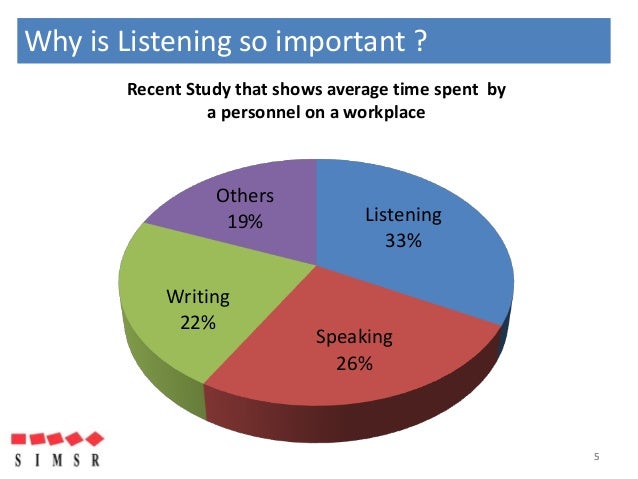
Listening is a very important aspect of being able to communicate with others. The importance of listening extends far beyond academic and professional settings. Understanding how to practice good communication even in your day to day life, among friends, family, and significant others, is important for a number of reasons: fostering good self-esteem, maximizing productivity and getting better grades in school, improving relationships, and even becoming a better speaker. Studies have also shown that speaking raises blood pressure, however listening actually lowers blood pressure.

The listening process involves 5 different steps: (taken directly from the Communication Blog - http://tcbdevito.blogspot.com/2011/04/communication-strategies-listening.html)

1.      Receiving - The first stage in the process of listening is receiving the message. At this stage you listen not only to what is said (verbally and nonverbally) but also to what is omitted. You receive, for example, your boss’s summary of your accomplishments as well as the omission of your shortcomings or, perhaps, vice versa. 
2.      Understanding - The second stage of listening is understanding the message. That is, after receiving the message, you process it and try extract the meaning from the message that the speaker wants you to come away with.
3.      Remembering - The third stage of listening is remembering the message. It would little help to you if you received and understood the message but didn’t remember it. If you want to remember what someone says or the names of various people, this information needs to pass from your short-term memory (for example the memory you use to remember a phone number just long enough to write it down) into long-term memory (or relatively permanent memory).
4.      Evaluating - Once you’ve received, understood, and have the message in memory, you need to evaluate it. After all, not all messages are equal, some are lies, and some are truths. Some can be significant and some can be trivial. Some are constructive, and on the other hand some are destructive.

5.      Responding - After you evaluate the message, you’re likely to respond in some way. And, of course, a speaker expects a response. This step shows the speaker that you were actually listening to what they were saying rather than just daydreaming. This is particularly important in a work setting, especially if your boss or somebody of upper management is the speaker.

Image result for importance of listening

Week 9 Post 1: Difficult Conversations


Difficult conversations are a thing that nobody wants to have, however it is almost guaranteed that you are going to engage in one no matter what field you work in, especially healthcare. Some sources of difficult conversations as a leader could be delivering bad news, discussing a sensitive or political topic, or talking about a project that was unsuccessful. These types of conversations cause stress and anxiety, however it is important that you address the topic and engage in the difficult conversation rather than avoiding it.

I found an article in the Harvard Business Review that gives 7 tips on how to deal with difficult conversations. The 7 tips are as follows: (taken directly from https://hbr.org/2009/03/7-tips-for-difficult-conversat) 

  1. Keep your goals realistic. You can’t ever eliminate the stress you’ll feel around telling your supplier you’re cutting back, but you can reduce it. Spend your energy on preparation – focus on developing your specific script.
  2. Give bad news upfront. Tough messages should be simply and clearly stated in the first sentence.
  3. Adopt the “And Stance”. Take control of the conversation by pre-empting distractions, objections and blame by using “and”. “I know you worked all night, and I know you want to do well, and I know you just joined the company, and I know the graphics people sometimes get the data wrong, and I know I could have been clearer in my directions to you….” And, and, and.
  4. Get out of the “blame frame.” Each person involved in the situation has a different objective story about what happened. Your goal is not to judge who’s right and wrong, it’s to manage to better outcomes in the future.
  5. Paraphrase. To create clarity and to let people know you’re genuinely listening, summarize what they’re telling you — and ask them to do the same.
  6. Be prepared for bad reactions. Finger-pointing, denial, arguments and tears are all possible outcomes of tough conversations. You cannot control the other person’s reactions, but you can anticipate them, and be emotionally ready.
  7. Pretend it’s 3 months or 10 years from now. Put the difficult conversation in perspective by thinking about the future. The conversations that are hardest right now will seem less daunting.

I believe that these are definitely useful tips in order to make difficult conversations easier and less anxiety filled. I will certainly keep these points of advice in mind for when I have to engage in a difficult conversation in the future. 

Tuesday, April 4, 2017

Week 8 Post 2: Checkers vs. Chess


While I was exploring the Harvard Business Review, I came across an article that caught my attention. The article was titled, “What Great Managers Do” by Marcus Buckingham. The author conducted research by using a study of 80,000 managers, the survey asked various questions regarding the manager’s management styles. Buckingham said that he found an abundance of different management styles, however he said there was one quality that truly sets great managers apart from the rest. This is that great managers discover what is unique about each person and then capitalize on it. He says that verge managers play checkers while great managers play chess. He goes on to explain that in checkers all the pieces are uniform and move in the same way and are ultimately interchangeable. In chess, there are many different pieces and each type of piece moves in a different way. You can’t play if you don’t know how each piece moves, but more importantly you won’t win if you don’t think carefully about how you move the pieces. In the business world great managers know and value the unique abilities and even the irregularities of their employees, and they learn how best to integrate them into a coordinated plan of attack. Capitalizing on a person’s uniqueness also builds a stronger sense of team. By taking the time to understand what makes each employee tick, a great manager shows that he or she sees their people for who they are. This personal investment not only motivates individuals but also galvanizes the entire team. To take great managing from theory to practice, the author says, you must know three things about a person: their strengths, the triggers that activate those strengths, and how they learn. By asking the right questions, squeezing the right triggers, and becoming aware of your employees’ learning styles, you will discover what motivates each person to excel. I believe this was a very educational article for future managers like myself and fellow classmates, and I will always remember the Checkers vs. Chess analogy.


Saturday, April 1, 2017

Week 8 Post 1: Mentorship Presentation


On Wednesday in class, Colleen and I presented to the class on the topic of mentorship and its importance in life as well as the workforce. I believe that it was a very educational and useful presentation for the class. They can use the information we presented in the future when they find a mentor or maybe even become a mentor themselves. Professor Bonica was away at a conference, so we used Facetime in order for him to be able to watch our presentation as well as make comments. I thought this was pretty cool because he was in another State but we were still able to conduct our class as if he was in the room.

A mentor is a person or friend who guides a less experienced person by building trust and modeling positive behaviors. An effective mentor understands that his or her role is to be dependable, engaged, authentic, and tuned into the needs of the mentee. A mentee is the person that is advised, counseled, and trained by the mentor. Mentorship is the relationship between the mentor and mentee in which the mentor  helps support and encourage the mentee to manage their own learning in order to maximize their potential, develop their skills, improve their performance and become the person they want to be.

The history of mentoring dates all the way back to Greek mythology, where it originated from Homer’s famous book, The Odyssey. The character Mentor coaches, advises, and counsels Odysseus’s son Telemachus. Mentor prepares Telemachus to take over the family responsibilities while his father Odysseus is away on his journey.
In our presentation we talked about five different types of mentoring, which are: Peer mentoring, Role Model mentoring, Reciprocal mentoring, Reverse mentoring, and Group mentoring.

Peer Mentoring: Individuals already having gone through the same experiences as you are now
    • Academic settings
    • Employment
    • Teams or extracurricular activities
  • Goals of the relationship:
    • Provide support
    • Encourage
    • Build confidence and trust
Role Model Mentoring: Mentor relationship in which the mentor is seen as a role model to the mentee
    • Mentee looks up to the mentor and seeks to imitate the mentors behaviors
  • 5 qualities of the Role Model Mentor:
    • Passion and ability to inspire
    • Clear set of values
    • Focused on well-being of others                                             
    • Selfless and accepting of others
    • Ability to overcome obstacles
  • Similar to Peer Mentoring as it is seen in academic, employment, and team settings.
Reciprocal Mentoring: Alternating roles as mentor and mentee
  • Both parties have similar experiences and success but a complementary skill set
  • Keys to success:
    • Goal setting
    • Accountability
    • Trust
  • Goals of the Relationship
    • Share knowledge
    • Gain insight
Reverse Mentoring: An initiative in which older executives are paired with and mentored by younger employees on topics such as technology, social media and current trends
  • Is primarily seen in Work/Employment settings
  • Criteria for Success:
    • Defined expectations: Each party needs to be very clear on their expectations
    • Willingness to learn: Both parties act in the capacity of a mentor as well as a mentee; so they must both genuinely want to learn from and share with each other
    • Trust: Reverse mentoring requires the trust of each party.  The goal is to push one another outside of their comfort zones and try new ways of thinking, working and being
    • Transparency: Both parties must be open with their feelings and with what they are thinking.  They must be able to overcome differences in communication style and be open to seeing situations from different angles
Group Mentoring: Multiple individuals acting as mentors and mentees
  • Peer Group vs. Team
  • Guidance rather than training
  • Benefits:
    • Multiple viewpoints
    • Cross-disciplinary and diverse perspective
Benefits of Mentoring

  • Benefits for the Mentee
    • Provides impartial advice and encouragement
    • Develops a supportive relationship
    • Offers professional development
    • Results in higher job satisfaction, salaries, and promotion rates
  • Benefits for the Mentor
    • Allows for growth of leadership capacity
    • Can learn valuable lessons from mentees
    • Helps strengthen interpersonal relationship skills
    • Leads to more personal satisfaction